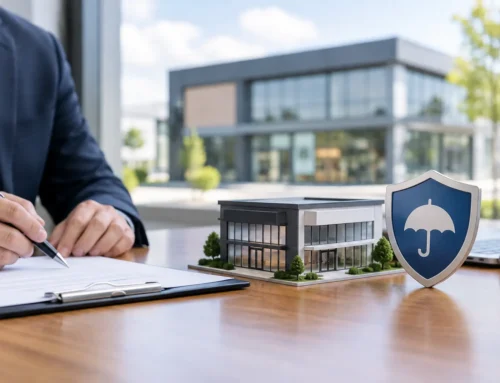

A fire closes a retail center for six months. The building can be repaired, but the financial pressure does not wait for construction to finish: rent stops, loan payments continue, and the owner may still be responsible for taxes, utilities, and payroll. Business interruption insurance commercial property coverage is designed for this period of forced downtime. For California owners and investors, it can be the difference between a property loss that is manageable and one that disrupts years of careful planning.
For a commercial landlord, the income produced by the building is not incidental. It supports debt service, operating obligations, reserves, and the long-term value of the asset. That is why business income protection deserves the same thoughtful attention as the building limit, liability coverage, and deductible.
What business interruption insurance covers for commercial property
Business interruption insurance, often called business income coverage, helps replace income lost when a covered cause of loss damages insured property and makes all or part of the premises unusable. It is generally included within, or added to, a commercial property policy. The coverage is triggered by direct physical loss or damage from a peril the policy covers, such as a fire, certain types of water damage, or windstorm damage, depending on the policy terms.
For a lessor’s risk property, the lost income is usually rental value: the rent a landlord would have earned had the covered loss not occurred. Coverage may also respond to continuing normal operating expenses during the restoration period. Those expenses can include mortgage interest, property taxes, insurance premiums, certain utilities, and other documented costs that continue while the building is being repaired.
The distinction matters. Property insurance pays to repair or replace covered physical damage. Business income coverage addresses the financial interruption created by that damage. A well-designed program considers both sides of the same event.
Rental value is not always simple
A fully leased office building with long-term tenants may have a relatively clear rental-income calculation. A mixed-use property, a retail center with percentage leases, or a building with newly signed tenants requires closer review. The policy should reflect the income the owner reasonably expects to earn, not simply last year’s collected rent.
Vacancies, free-rent periods, tenant improvement work, seasonal operations, and lease renewals can all affect the calculation. A thoughtful insurance review considers the leases and the property’s operating reality rather than relying on a generic percentage of the building value.
How the restoration period works
Business income coverage does not pay indefinitely. Most policies measure payment through the “period of restoration” – the time it should reasonably take to repair or replace damaged property with due diligence and dispatch. It commonly begins after a waiting period, often 72 hours, although the exact terms vary by policy.
This is where owners should avoid assumptions. The restoration period is not necessarily the date a tenant decides to reopen, the date a lender is satisfied, or the date every improvement is complete. It is tied to the covered damage and the reasonable repair timeline. Permitting delays, material shortages, code requirements, contractor availability, and post-catastrophe demand can make that timeline far longer than expected.
California commercial properties may face especially complex rebuilding conditions after a wildfire or widespread storm event. In affected regions, qualified contractors and materials can become difficult to secure, while local permitting departments may be under intense pressure. Extended business income coverage can provide an additional period of protection after repairs are complete if income does not immediately return to its prior level. Whether it is appropriate depends on the property, tenant mix, and anticipated path to re-occupancy.
Business interruption insurance commercial property owners should review
The right amount of business income coverage starts with a clear understanding of the income at risk and the likely duration of a severe loss. Underestimating either can leave a meaningful gap at the moment the coverage is needed most.
Owners should examine scheduled base rent, recurring reimbursements that would be lost, and expenses that would continue even if the building is vacant after a covered event. For larger assets, the review should also account for loan covenants, management agreements, and reserve requirements. A lender may require insurance protections that are different from, or more specific than, the owner’s initial assumptions.
The indemnity period deserves equal attention. A modest interior loss may be restored quickly. A major fire affecting the structure, electrical systems, fire protection components, and tenant spaces can require extensive engineering, permitting, and reconstruction. A 12-month limit may be sufficient for one location and inadequate for another. Strategic coverage is based on the property’s real recovery timeline, not a hopeful one.
Do not confuse lost rent with tenant liability
Commercial leases often contain insurance provisions that require tenants to carry their own coverage. That can be valuable, but it does not replace the landlord’s business income protection. A tenant’s policy is intended to protect that tenant’s operations and property. The building owner needs coverage tailored to the owner’s rental income, continuing obligations, and interest in the structure.
Lease language should also be reviewed alongside the insurance program. Does the lease allow rent abatement after casualty? Who is responsible for certain repairs? Is the tenant required to continue paying charges that survive a casualty? These provisions can affect the income calculation and claims process.
Extra expense coverage can protect the recovery plan
Extra expense coverage pays certain necessary expenses incurred to avoid or minimize a business income loss after covered damage. For an owner or property manager, that may include temporary office space, additional security, emergency communications, temporary equipment, or costs associated with keeping portions of a property operational.
Consider an apartment complex with damage to a central utility system or common area that affects habitability. The property owner may need to act quickly to protect residents, preserve the site, and reduce vacancy exposure. Extra expense coverage may help with eligible measures that support a faster, more orderly recovery.
Coverage is not a blank check for betterments or unrelated upgrades. The expense must be necessary, reasonable, and connected to a covered loss under the policy. Still, when structured correctly, it gives owners more flexibility to protect the asset and its income stream while repairs are underway.
Common gaps that deserve attention
Business income coverage has important limitations. Flood and earthquake losses are commonly excluded from a standard commercial property policy and may require separate solutions. Wildfire protection also depends on the form, carrier appetite, location, and policy wording. In California, a property located in a high-risk fire area calls for especially careful coordination between property limits, deductibles, business income coverage, and any specialty market placement.
Civil authority coverage is another area where the details matter. It may provide limited business income protection when a government authority prohibits access to the premises because of covered damage nearby. However, it is usually subject to specific triggers and time limits. A road closure, evacuation order, or public safety restriction does not automatically create coverage in every situation.
Ordinance or law coverage should be considered as well. When rebuilding triggers code upgrades, the physical property policy must be equipped to address eligible added costs. Longer construction timelines created by those upgrades can also affect the business income period. The coverage pieces should work together rather than leave the owner to manage a gap between rebuilding costs and lost income.
Preparing before a loss improves the claim
A business income claim is supported by records. Keep current leases, rent rolls, operating statements, tenant correspondence, property tax records, loan documents, and documentation of recurring expenses in a secure location outside the premises or in protected digital storage. After a loss, maintain a detailed log of events, communications, repair decisions, invoices, and steps taken to reduce further damage.
Owners should also have a practical continuity plan. Identify who can authorize emergency work, how tenants will receive updates, where critical documents are stored, and which vendors can help stabilize the property. Insurance is a vital financial safeguard, but a well-managed response protects relationships with tenants, lenders, and the surrounding community.
Koda Insurance Services helps commercial property owners look beyond the building limit and evaluate the income their assets are meant to produce. We treat every client like family, bringing clear guidance and tailored risk management to significant property decisions. Before the next renewal, review the numbers behind your rental income and the time your property would realistically need to recover. That conversation can help protect what matters most when your building cannot generate income.